
Can You Buy a Car With Bad Credit in Dallas? A Step-by-Step Guide

Can You Buy a Car With Bad Credit in Dallas? A Step-by-Step Guide
Quick Answer
Yes. In the Dallas–Fort Worth area, bad credit changes who will finance you and what you have to bring — it rarely ends the search. Banks and credit unions may weigh your credit history and score alongside your income, debt-to-income ratio and their own underwriting requirements, and criteria vary by lender. Dealerships that finance their own sales may place more emphasis on what you earn now, where you live, what you can put down, and whether you can document all three, though qualification criteria vary by dealership. Approval is never automatic, and it depends on each lender’s own criteria. But the process is predictable, and most of the work happens before you set foot on a lot.
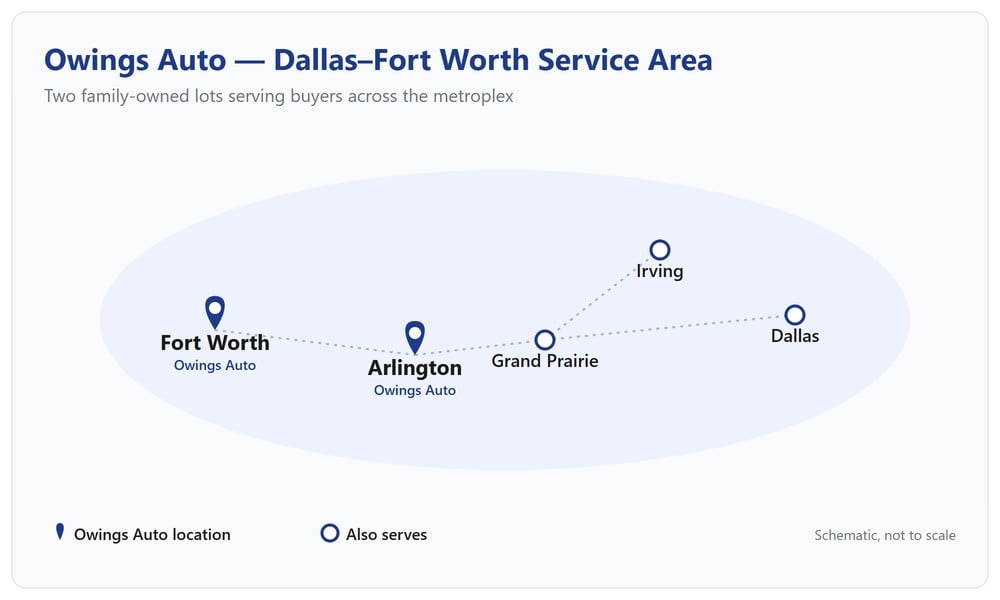
One thing worth saying plainly at the top: Owings Auto is a family-owned dealership that has financed its own sales in North Texas since 1985, with lots in Arlington and Fort Worth and none inside Dallas. Most of what follows is general to any bad-credit purchase in the metroplex; where something is specific to Owings, it says so.

What “bad credit” actually means to a dealership
“Bad credit” is not one condition, and the fix is different for each version of it. A buyer with a damaged score, a buyer with no credit file, and a buyer eighteen months past a repossession can each be turned down by the same bank for three different reasons. Knowing which one describes you tells you where to apply and what to prepare.
The distinction that trips people up most often is bad credit versus no credit. Bad credit means there is a repayment history and some of it went wrong. No credit means there is barely a file to read, which is common for younger buyers, recent arrivals, and anyone who has always paid cash. Both are harder to finance conventionally, but the second is often the easier of the two, because there is nothing negative to weigh.
| Your situation | How a conventional lender tends to weigh it | What an income-based lender may weigh instead |
|---|---|---|
| Low score, late payments | Score and repayment history can weigh heavily, alongside income and debt-to-income | Current income, how long you have held the job, and whether the payment fits what is left after your bills |
| No credit file at all | Little history to score, so more may rest on income, debt-to-income and the lender’s own requirements | Proof of income and a stable address usually carry more of the weight |
| Repossession in your past | Weighed as part of your repayment history, and the criteria vary from one lender to the next | Whether the circumstances have changed and the new payment is realistic on today’s income |
| Bankruptcy | Weighed alongside the rest of your credit file, and the criteria vary from one lender to the next | Whether the case is discharged or still open — say which up front so the dealership can tell you what it needs |
| Self-employed, paid in cash, or ITIN-only | Income can be harder to document in the format underwriting expects | Bank statements and invoices that show the same money landing every month |
Every answer in the right-hand column is something you can put on paper before you apply. The table describes how these two kinds of lender generally work across the market rather than the criteria of any one dealership: one generally leans more on your credit history, the other more on documents about your present. Criteria vary by lender, and applications are evaluated individually.
Which financing route fits your situation
There are three ways to finance a used car, and they can approve people on different grounds because different parties carry the risk, so criteria vary by lender. Working out which one you are realistically in is what keeps a search from stalling.
| Route | Who holds the loan | What tends to decide it | Realistic if… |
|---|---|---|---|
| Bank or credit union | The bank, before you pick a car | Credit history and score, income, debt-to-income, and the lender’s own requirements | Your file is thin rather than damaged, or you have a strong cosigner |
| Dealer-arranged financing | An outside lender the dealership sends your application to | That lender’s own credit tiers | Your credit is bruised but not severely damaged; terms vary a lot by tier |
| In-house financing | The dealership itself, for the life of the loan | More emphasis on current income, residence and documentation; criteria vary by dealership | You have been declined elsewhere, or there is a repossession or bankruptcy in the file |
This is general information about how the three routes commonly work, not a description of any one dealership’s requirements. Each financing route uses its own qualification criteria, and applications are evaluated individually. Rates, terms, qualification criteria and total borrowing costs vary between these routes, so compare the complete offer rather than the monthly payment before you decide. For a fuller side-by-side, see in-house financing versus a traditional auto loan.
How to buy a car with bad credit in Dallas, step by step
Eight steps, in the order that saves the most money and the most driving. Steps one through four happen at your kitchen table.
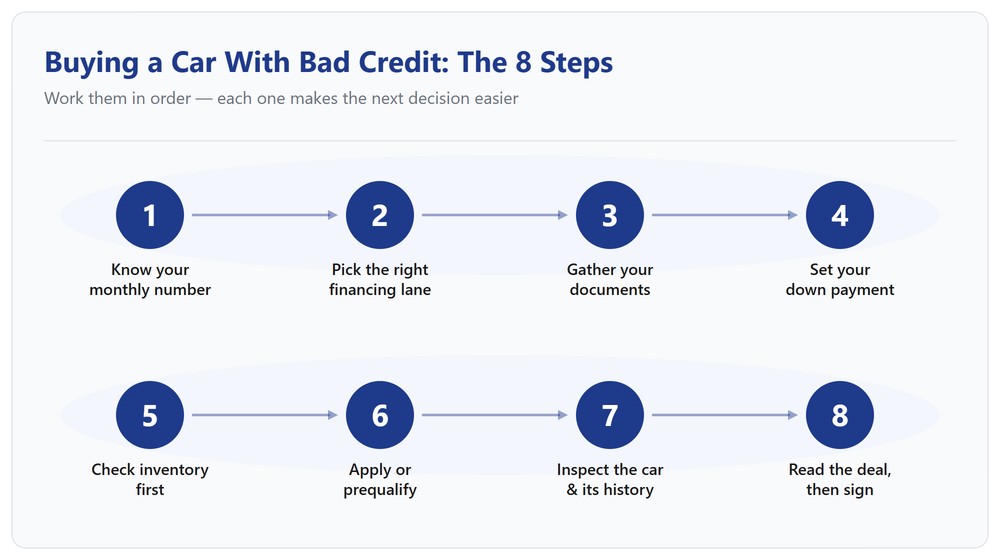
- Work out your monthly number before you shop. Not the largest payment you could be approved for — the payment that still leaves you solvent once insurance, fuel and repairs are counted. The Consumer Financial Protection Bureau warns against judging affordability by the sticker price alone, because it ignores interest, taxes, fees and running costs. Our Texas car budget guide walks through the arithmetic.
- Pull your credit reports and fix what is wrong. Free copies of all three bureau reports come from AnnualCreditReport.com, and the CFPB recommends reviewing them for errors before you apply. An account that was paid off but still shows a balance, or a debt that is not yours, is worth the week it takes to challenge, especially if a bank loan is still within reach.
- Gather your documents. With an income-based lender, the documents you bring can carry much of the application. The checklist in the next section is what to assemble, and having it complete gives you the best chance of finishing in one visit.
- Decide what you can genuinely put down. A larger down payment may reduce both the monthly payment and the total cost of the loan, per the CFPB, but only money you will not need back. Draining the account for a bigger down payment and then missing the first insurance premium is a bad trade. Down payments are set per vehicle, so any number quoted before you have picked a car is only an estimate.
- Check what is actually on the lot before you apply. Used inventory turns over quickly, and an approval is only as useful as the cars it can be spent on. Look at the current inventory first, note two or three realistic candidates, and confirm they are still in stock before you drive out.
- Apply or prequalify. Owings Auto takes applications online through its credit application. Owings Auto states that financing is available for qualified buyers and that approval is not guaranteed and is subject to underwriting criteria. Qualification criteria apply, and applications are evaluated individually. Wherever you apply, expect your application to be reviewed before you get an answer.
- Inspect the car and check its history. Financing being settled does not make the car sound, and with a fixed loan you cannot walk away from a bad engine the way you could from a bad rate. Use our used car inspection checklist, and if the price looks unusually low, confirm the title is clean — a rebuilt title explains a lot of bargains.
- Read the deal, then sign. This is the step buyers rush after a long day and a hard-won yes — and the one worth slowing down for. The six-line contract check further down takes about ten minutes.
What to bring when you apply
When a lender places more emphasis on current financial circumstances, the documentation you provide becomes especially important. The list below is what Owings Auto publishes for its Arlington and Fort Worth lots. Bring originals or clear photos, use the most recent documents you have, and make sure the name and address match across all of them, since a mismatch can delay an otherwise fine application.
Document checklist
Assemble these before you apply, not after.
- ☐ Texas driver’s license — or a cosigner who holds one.
- ☐ Proof of income — recent pay stubs, or bank statements if you are self-employed or paid in cash. Owings publishes a minimum of $2,000 a month in net income; confirm the current figure when you apply.
- ☐ Proof of residence — a recent utility bill or a lease in your name.
- ☐ Proof of insurance — you will need coverage in place before you drive the car home, so get quotes on your shortlisted vehicles in advance. Premiums vary more than buyers expect from one car to the next.
- ☐ Your down payment — and a quick call ahead to confirm which payment forms the dealership accepts.
- ☐ Contact details you can verify — a working phone number and, if you have recently moved, something tying you to the new address.
Not sure your paperwork clears the bar? Asking costs nothing and saves a wasted trip. Owings takes applications through its online credit application, or you can call either lot on 817-548-9955 and ask what they would need from someone in your situation.
How to read the financing offer before you sign
A financing offer is usually described as a payment. “Two hundred a month, a thousand down, and you can take it today.” That is one number, and it sits on top of four others that decide what the car actually costs you. Get all five written down before you agree to anything, so you know what you are comparing.
| The number | What it tells you | What to check |
|---|---|---|
| Sale price | What the car costs before any financing | It matches the price sheet or the listing you shopped from. If it moved after your approval came through, ask what changed |
| Down payment | What you hand over today | It is usually set per vehicle rather than per customer, so it moves when you change cars. Check which payment forms the lot takes before you drive out |
| Amount financed | Sale price minus your down payment, plus whatever else got rolled in | Tax, fees and any add-on you agreed to all land here, and you pay interest on every dollar of it for the whole term |
| The rate | What the borrowing itself costs | Ask whether the figure you were quoted is an APR. A rate expressed some other way, such as a few dollars added per $100 financed, sounds smaller than the APR it works out to |
| Payment and term | How much, how often, and how many times | A weekly payment is not a monthly one divided by four. Payment multiplied by number of payments is what the car costs you in the end |
Do the multiplication yourself, on every offer. If an offer uses weekly or biweekly payments, convert the payment frequency into a total cost and approximate monthly amount before comparing offers. Ninety-five dollars a week for three years is 156 payments, not 36. That is about $412 a month and $14,820 by the end. Run the same multiplication on every offer you are given, so two deals described to you in different units end up as one comparable number.
Ask about the rate early in the process. The sooner you know the rate and the total financing cost, the more time you have to compare your options and work out what fits your budget. Owings Auto publishes APR options of 15.9% to 17.9% on its site, so that part of the arithmetic can be done at home. Wherever you are shopping, ask early and write down what you are told.
Five questions worth asking out loud. What is the total of all the payments on this car? Is the rate you quoted me an APR? What is in the amount financed besides the sale price? What is included with the car, and can I have that in writing? And is there any cost to paying it off early? Write the answers down on every car you are considering, so you have enough information to compare offers side by side.
Check the contract against these six lines
The CFPB’s advice, in one sentence: make sure the paperwork matches the deal you think you are getting.
- ☐ The APR printed on the contract is the rate you were quoted out loud.
- ☐ The sale price matches the price sheet or the listing you shopped from.
- ☐ The payment amount, its frequency, and how many payments there are — a weekly figure is not a monthly one divided by four.
- ☐ Every added product or fee is itemized with a price, and nothing on the list is something you did not ask for.
- ☐ The coverage you were promised on this car appears in the paperwork, in writing. “Sold as is” and “covered” are two very different cars.
- ☐ The late-payment and default terms — read them once while nothing has gone wrong.
What the car costs beyond the price you agreed
The sale price is not what the car costs you. Four other things land on top of it, and leaving them out of the budget is why a payment that felt comfortable at the desk stops feeling that way in month three. Work them out before you shop, not after you sign.
Taxes, title and registration costs. Taxes, title and registration costs and any dealership charges are all part of what the purchase costs you. Ask what the out-the-door total is, and budget from that number rather than from the price on the windshield.
Insurance. Get quotes on your shortlist before you commit to one of them. Two cars at the same price can differ by several hundred dollars a year to insure, and on a tight budget that gap is not a detail, it is the decision. It is a much easier number to find out before you sign than after.
Fuel and routine upkeep. Fuel, oil changes, tires and brakes are the running costs that turn a comfortable payment into a tight one. Ask what the car has recently had done and what it is due for. A set of tires or a brake job shortly after purchase is a common expense on an older vehicle, and it is much easier to absorb if you were expecting it.
Unexpected repairs. Keep a repair fund separate from the payment, because the cheapest car on the lot is rarely the cheapest car to run. Our Texas car budget guide puts numbers to all of it.
Mistakes that cost bad-credit buyers the most
These are the ones that come up again and again, and none of them are about the credit score.
- Arriving with nothing to prove. When approval rests on income, a missing pay stub can hold things up more than a low score does. Incomplete paperwork can delay an application that would otherwise move.
- Spreading applications across months. The CFPB advises keeping credit inquiries within 14 to 45 days of each other so scoring models count them as one. Compare over two weeks, not over two seasons.
- Putting down money you will need back. A bigger down payment lowers the loan, but not if it leaves nothing for the insurance premium, the registration or the first repair.
- Signing add-ons in without pricing them. Anything folded into the contract increases the amount financed, and you pay interest on it for the full term. Ask what each line costs on its own before it goes in.
Who in-house financing fits — and who should compare alternatives
In-house financing is a good fit when a bank has already said no and you need a working car sooner than you can rebuild a credit file. It suits buyers with steady, documentable income, a stable address, a real down payment, and a low score, a thin file, a past repossession or a discharged bankruptcy behind them. The emphasis tends to fall on evidence you can produce today rather than on a score, and what you should do in return is look at the complete offer, not only the payment.
Compare other options first if any of these describe you. If your credit is bruised rather than broken, it is worth getting a bank or credit union pre-approval so you have a complete offer to compare against. If your reports contain errors you have not disputed, fixing them can move you a tier. If you can wait a few months without losing your job over transport, waiting is cheaper than borrowing. And if you want a late-model vehicle with a manufacturer’s warranty still on it, that is a different kind of lot. For the metroplex-wide view of where to buy near Dallas, or a side-by-side comparison of two in-house dealerships, we have written both.
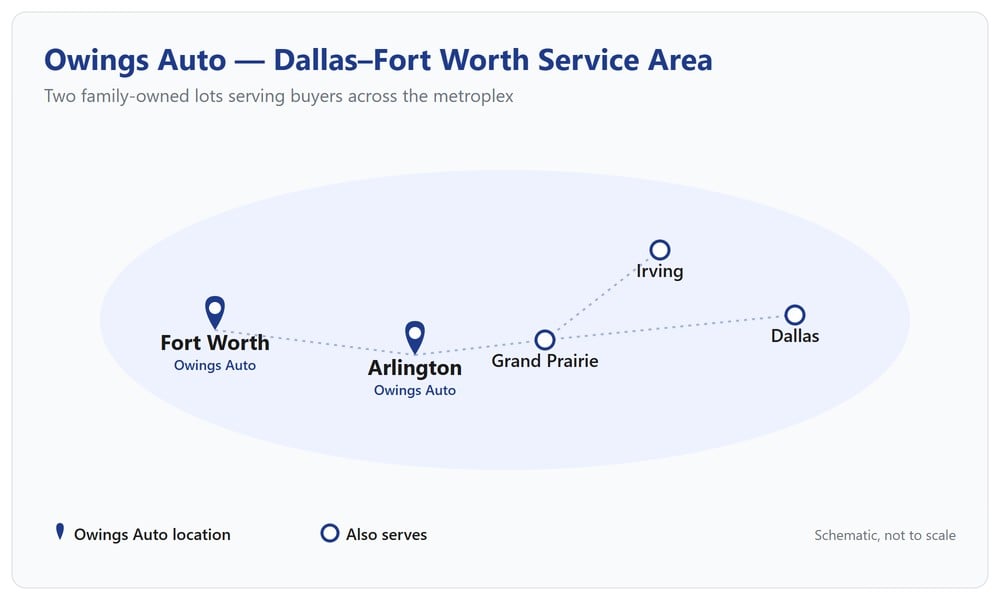
Owings Auto has been financing its own sales in North Texas since 1985. What the site publishes: financing handled in-house, with no banks involved and no credit score minimum; APR options of 15.9% to 17.9%; a printed price sheet every customer receives showing each vehicle’s sale price, down payment and weekly payment; a minimum of $2,000 a month in net income, plus proof of residence; and a free 24-month / 24,000-mile service contract on every vehicle Owings Auto sells, covering the engine, transmission, water pump, fuel pump and radiator, backed by an on-site shop. Ask for the service contract terms in writing when you buy. Both the Arlington and Fort Worth locations are open Monday through Friday from 9:00 AM to 6:00 PM and Saturday from 9:00 AM to 5:00 PM. Both locations are closed Sunday.
Ready for the next step? Look through the current inventory to see what your budget actually reaches, then start a credit application to get real numbers on a real car. Financing is available for qualified buyers; approval is not guaranteed and is subject to underwriting criteria. Questions first? Call either lot on 817-548-9955.
The bottom line
Buying a car with bad credit in the Dallas area is less about persuading someone to overlook your score and more about arriving with the evidence that makes the score beside the point. Know your monthly number, fix what your credit reports get wrong, work through the document checklist, decide a down payment you can actually spare, and read the offer as five numbers rather than one payment. Do that, and the part everyone dreads, the yes or no, turns into the least stressful step of the process.
Frequently Asked Questions
Can I buy a car with no credit history at all?
Often yes, through an income-based lender. Having no credit file is a different problem from having a damaged one: there is nothing negative to weigh, but also nothing to score. Banks and credit unions generally weigh credit history, score, income, debt-to-income and their own underwriting requirements, and a thin file can give them little to assess. A dealership that finances its own sales may place more emphasis on your current financial circumstances and the documentation you can provide, such as income, residence and a down payment. Approval still is not automatic, and qualification criteria vary by dealership.
How much of a down payment do I need with bad credit?
There is no single number. The amount depends on the car’s price and on the terms you qualify for, so a figure quoted before either one is known is only an estimate. At Owings Auto, down payments vary by vehicle and are shown on the printed price sheet for each car. As a general principle, the Consumer Financial Protection Bureau notes that a larger down payment may reduce both your monthly payment and the overall cost of the loan.
Can I get financed after a repossession or bankruptcy in Texas?
Financing may be possible, but approval is never automatic and the criteria vary from one lender to the next. A repossession or a bankruptcy is weighed as part of your credit history. Lenders that finance their own sales may place more emphasis on your current financial circumstances and documentation, though qualification criteria vary by dealership. If you are currently going through bankruptcy, explain your situation before applying so the dealership can tell you what information it needs to evaluate your application.
Will applying for car financing hurt my credit score?
The Consumer Financial Protection Bureau advises keeping credit inquiries within 14 to 45 days of each other so that scoring models count them as a single inquiry for rate shopping. Do your comparing inside a couple of weeks rather than a couple of seasons, and ask each lender what kind of inquiry it will run before you apply.
What should I check before choosing a car with bad credit?
Six things, in roughly this order. What the payment leaves you at the end of the month, rather than the largest payment you could be approved for. How much you can genuinely put down without emptying the account. The vehicle’s condition and history, since settled financing does not make a car sound. Insurance quotes on your shortlist, because two cars at the same price can differ by several hundred dollars a year to insure. The financing terms read as separate numbers: sale price, down payment, amount financed, the rate, and the payment together with how many payments there are. And the total cost, which is the payment multiplied by the number of payments, plus what the car costs to run.
What is the difference between in-house financing and a bank auto loan?
Who holds the loan, and therefore what decides the answer. A bank or credit union typically approves you before you pick a car and may weigh your credit history and score alongside your income and debt-to-income. With in-house financing the dealership keeps the loan on its own books and may place more emphasis on your current financial circumstances and documentation, though qualification criteria vary by dealership. Rates, terms, qualification criteria and total borrowing costs vary between the two, so compare the complete offer rather than the monthly payment before you decide which one fits.

Trade In Your Car at a Buy Here Pay Here Dealership (2026)
Can You Trade In Your Car at a Buy Here Pay Here Dealership? By The Owings Auto Team · Reviewed…

Buy Here Pay Here Near Dallas: Where Should You Buy?
By The Owings Auto Team · Updated July 2026 · About a 9-minute read Quick Answer If you need Buy…
Owings Auto vs DriveTime: Which Is Better for Bad Credit? (2026)
By The Owings Auto Team · Updated July 2026 For a bad-credit buyer in Dallas–Fort Worth, the choice is between…