
Trade In Your Car at a Buy Here Pay Here Dealership (2026)

Can You Trade In Your Car at a Buy Here Pay Here Dealership?
Quick Answer
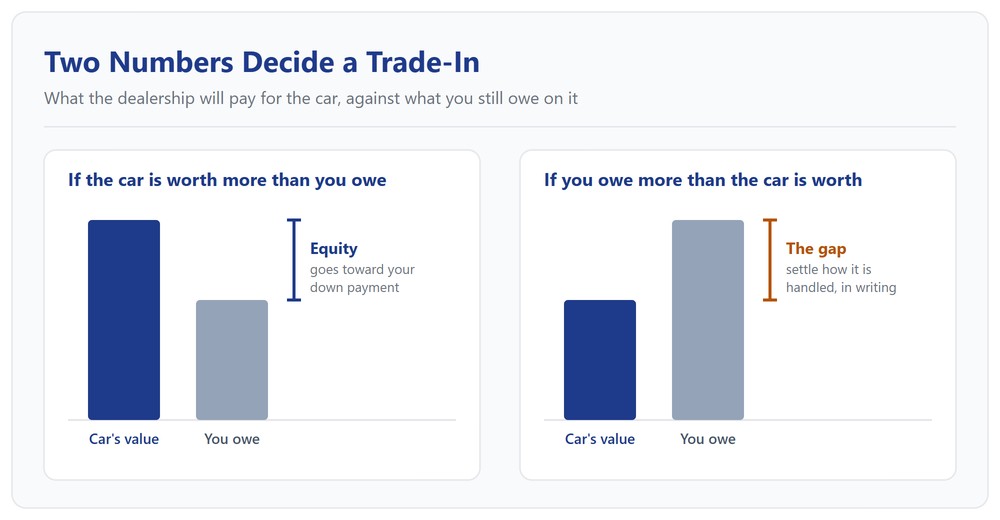
In most cases, yes. Many dealerships accept trade-ins, including lots that finance their own sales: the dealership puts a value on your current vehicle, and that value goes toward your purchase. Policies and appraisals vary from one dealership to the next. Two numbers decide how much it helps you. One is what the dealership will pay for the car. The other is what you still owe on it, if anything. When the value is the larger of the two, the difference is equity, and equity can go toward your down payment. When the amount owed is larger, the difference does not disappear at the moment you hand over the keys, so review in writing how that balance affects the transaction before you agree to anything. What a trade-in does not do is change the criteria you are assessed against. It is a payment, not a qualification.
Trade-in vehicles must be brought to an Owings Auto lot for an in-person evaluation. Owings Auto cannot provide a trade-in amount until the vehicle has been inspected at the dealership. Acceptance and value depend on the individual vehicle.
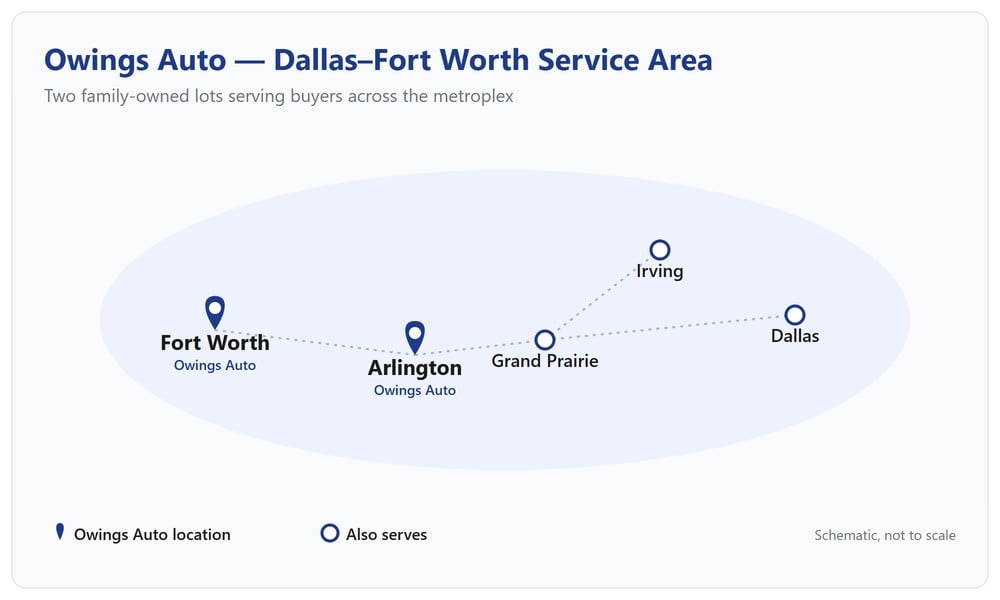
One thing worth saying at the top: Owings Auto is a family-owned dealership that has financed its own sales in North Texas since 1985, with lots in Arlington and Fort Worth. Most of what follows applies to trading a car in anywhere. Where something is specific to Owings Auto, it is based on information published by the company or confirmed directly by its team.

Can you trade in a car at a buy here pay here dealership?
In most cases, yes, though policies and appraisals vary from one dealership to the next. A lot that finances its own sales still buys and sells used cars for a living, so many of them accept trade-ins, though whether a particular dealership does, and on what terms, varies.
How it works at Owings Auto. Trade-in vehicles must be brought to an Owings Auto lot for an in-person evaluation. Owings Auto cannot provide a trade-in amount until the vehicle has been inspected at the dealership. Acceptance and value depend on the individual vehicle. Contact Owings Auto before visiting if you have questions about bringing in the vehicle.
What varies from one dealership to the next is which vehicles they want and what they will pay. A lot that mostly stocks sedans and small SUVs values a work truck differently from a lot that specializes in trucks, and both are being rational. That is why the only trustworthy figure for your car is an appraisal of your car, on the day, at the place you are actually buying from.
Keep one distinction clear before you go: a trade-in is a payment, not a qualification. It reduces what you need to finance, in the same way cash would. It is not a substitute for meeting whatever criteria the dealership applies, and it does not make an application succeed on its own. Buyers sometimes arrive expecting the car in the driveway to do work that it cannot do, and the disappointment is avoidable. If you want the fuller picture of how a lot that carries its own loans differs from a bank, we have written that up separately in our guide to in-house financing versus a traditional auto loan.
How a trade-in works, step by step
A trade-in generally runs in six steps, and the two that change the outcome most both happen before you leave the house. The rest is an appraisal, an offer, and one piece of follow-up almost everybody forgets.
General industry guidance. The six steps below describe how trade-ins commonly work across the used-car business. They are not a description of Owings Auto’s process. At Owings Auto, the vehicle is evaluated in person at the lot, and no amount can be given before that inspection.
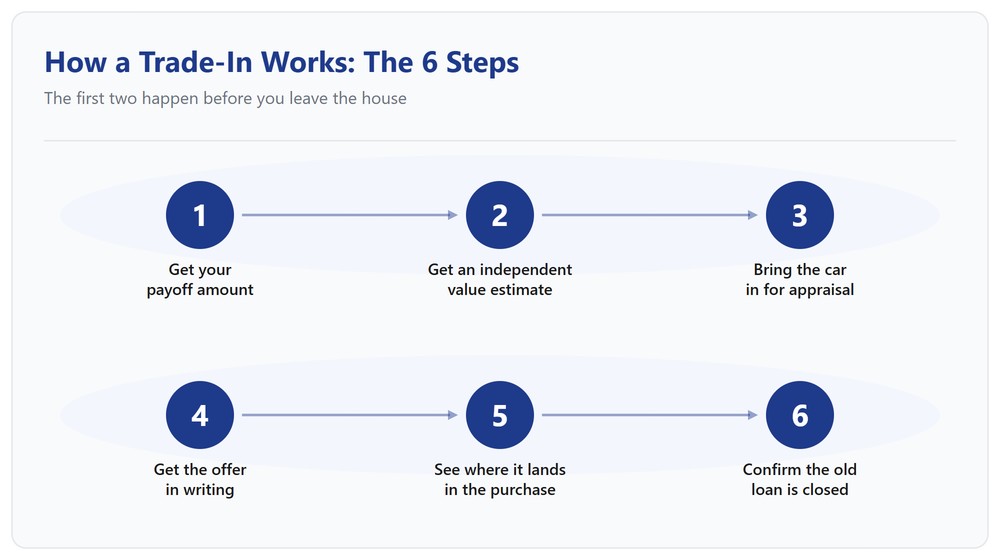
- Find out what you actually owe, if anything. The figure you want is the payoff amount, not the balance printed on last month’s statement. A payoff quote covers the principal plus interest up to the day the loan is settled, so it is usually a little higher than the balance you are used to seeing. Call your lender and ask for a payoff good through a specific date. The Consumer Financial Protection Bureau puts this first for the same reason we do: without it, every other number in the conversation is guesswork.
- Get an independent estimate of what the car is worth. Free valuation tools from the well-known guides will give you a range in a few minutes. Use the trade-in figure rather than the private-party or retail figure, and answer the condition questions honestly, because an optimistic self-assessment only sets you up to be disappointed later. These tools are run by independent third parties: the number they produce is an estimate of what the market looks like, not an offer from Owings Auto or from any other dealership. The point of the estimate is not to arrive with a number to argue for. It is so you have useful context when you review the appraisal.
- Bring the car in for an appraisal. Someone will drive it, look underneath, check the tires and the panels, and run the vehicle identification number for its history. Expect this to take a little time, and expect the number to differ from your online estimate in one direction or the other. Bring the paperwork listed further down so nothing has to be finished on a second visit.
- Get the offer in writing, on its own. Ask for the trade-in figure as a separate line alongside the monthly payment. Two offers with similar monthly payments can carry different trade allowances, so seeing the trade-in figure on its own makes them easier to compare. This is the same principle as reading a financing offer as separate numbers rather than as one figure, and it matters here for exactly the same reason.
- See where the number lands in the purchase. Equity from the trade reduces what you have to put down in cash, or reduces the amount you finance, or some of both. Ask which, and ask to see it written on the paperwork for the specific car you are buying, since at Owings the down payment is set per vehicle and shown on that vehicle’s price sheet. Look at the current inventory before you go so you already know roughly what your trade needs to reach.
- If there was a loan on the car, confirm it actually closed. This is the step almost everybody skips. The CFPB’s advice is to make sure the original loan has been completely paid off with no outstanding payments, and to wait a week after the sale, then contact the old lender yourself and check. An account that stays open because a payment crossed in the mail is a problem that is far easier to fix in week two than in month six.
What decides how much your trade-in is worth
An appraisal is an estimate of what the car will sell for next, minus what it will cost to get it ready. Everything an appraiser looks at feeds one of those two halves. Knowing which is which tells you where a bit of preparation is worth the effort and where it is not.
| What is looked at | Why it moves the number | Worth doing before you go |
|---|---|---|
| Mileage | It sets expectations about how much life is left before the next round of major work | Nothing, beyond knowing the reading before you arrive so the estimate you got matches the car |
| Mechanical condition | Reconditioning needs identified at the appraisal may affect the value placed on the vehicle | Mention faults rather than hiding them. They surface in the inspection, and a surprise costs more trust than the fault costs money |
| Cosmetic condition | Reconditioning is a real cost, and a car that looks cared for reads as one that was | Clean it inside and out and empty it. This is the cheapest thing on this list and the one that most reliably pays for itself |
| Service history | Records are evidence about the half of the car nobody can see in a walkaround | Dig out whatever you kept, even if it is a folder of receipts rather than a stamped book |
| Title and accident history | A branded title or a recorded major accident follows the vehicle identification number and affects what it can be resold for | Know what your title says before the appraisal. Our guide to rebuilt titles explains the branding |
| Local demand for that model | A car that sells quickly in this market is worth more than the same car that sits | Nothing you can change, but it explains why the same car is valued differently at two lots |
Two things are worth noticing in that table. The only entries you can influence in an afternoon are cleaning the car and finding your paperwork. And the most expensive-sounding item, mechanical condition, is the one to be most careful about, since there is no guarantee that money spent on repairs before an appraisal will be reflected in the value placed on the vehicle.
Why the trade-in offer is lower than the price on similar cars
Because a trade-in figure and a windshield price are two different measurements, and the gap between them is the cost of turning one into the other. This surprises people every time, and it is worth understanding before you review an appraisal.
The same car has several published values at once. Kelley Blue Book, whose figures many buyers check first, defines them separately. Its Trade-In Value is “an estimate of what a consumer can expect to receive from a dealer for a trade-in vehicle assuming an accurate appraisal of condition,” and it says that value “will likely be less than the Kelley Blue Book Private Party Value because the reselling dealer incurs the cost of safety inspections, reconditioning and other costs of doing business.” Below both sits the Auction Value, which assumes the car “has not yet been fully reconditioned, inspected, and prepared for retail sale.”
So the car you are trading has to be inspected, repaired where necessary, cleaned, photographed and advertised before it can carry the price you saw on a similar vehicle. All of that sits between the number you are offered and the number on the windshield. Once you see the offer as the retail figure minus that work, a number that looked low often turns out to be arithmetic.
Offers still vary, and it is always worth asking questions. The comparison worth making is between offers, or between the offer and what a private sale would realistically net you after the listing, the strangers in your driveway and the weeks of waiting. Compare like with like, and be honest about what your own time is worth.
Can you trade in a car you still owe money on?
Owing money on the car does not by itself rule out a trade. It changes the arithmetic rather than ending the conversation. Everything depends on two numbers you can establish before you go anywhere: the payoff quote from your current lender, and the value a dealership puts on the vehicle.
| Where you stand | What it means | What to ask for in writing |
|---|---|---|
| Value is higher than the payoff | You have equity. The difference belongs to you | The equity figure, and exactly where it is applied: toward the down payment, toward the amount financed, or split |
| Value and payoff are close | The trade roughly cancels the loan and contributes little else | A written confirmation of how the payoff amount is reflected in the transaction |
| Payoff is higher than the value | This is negative equity. The gap is real and it does not vanish with the keys | A written breakdown of how that balance affects the transaction, before you agree to anything. Do not assume it has been accounted for |
Being underwater is common enough that it should not stop you asking. Edmunds put the share of trade-ins toward new-vehicle purchases carrying negative equity at 29.6% in the second quarter of 2026, with the average shortfall at $6,884, the highest second-quarter figure it has recorded and up from 26.6% a year earlier. Close to one trade in three. Whatever else it is, it is not unusual, and there is no reason to feel awkward putting the numbers on the table.
What matters is what happens to the gap. The CFPB’s guidance is direct on this: understand how a rolled-over balance affects the total cost of the new loan, and look at the amount borrowed, the APR, the term and the payment together before agreeing to anything. It also points to confirming how the payoff appears on the paperwork. If a payoff is part of the deal, review how that amount is reflected in the transaction and in the new financing, so the figures are clear before you agree to anything.
This is a conversation to have with the numbers in hand, and the specifics of any particular deal belong in that conversation rather than in an article. If you are considering Owings Auto, take the payoff quote with you when you bring the vehicle in: it has to be evaluated in person at the lot before any trade-in amount can be given, and acceptance and value depend on the individual vehicle.
Four questions worth asking about a trade with a loan on it. What figure are you allowing for my car? What payoff amount are you working from, and what date is it good through? How does the difference between those two figures appear on the paperwork? Write the answers down. Contact Owings Auto before visiting if you have questions about bringing in the vehicle.
If your car is older, high-mileage or not running
Ask rather than assume, because the answer depends on the vehicle and the appraisal. An old car with a lot of miles on it may still have trade-in value, and so may a car that will not start, depending on its condition and how it is appraised. Whether that value is enough to cover a large down payment depends on the vehicle and the dealership, so the useful question is not simply whether it is worth something but whether it is worth enough to change your plan.
Three things are worth keeping in view. First, resist the temptation to fix it up first. There is no guarantee that money spent on repairs before an appraisal will be reflected in the value placed on the vehicle, and you cannot get it back. Get the car valued as it stands, and let the offer tell you whether further spending makes sense. Second, if the car is undrivable, say so when you call, because how it gets to the lot is a practical question worth settling in advance rather than on the day. Third, compare the offer against a realistic private sale rather than an ideal one: not the highest asking price you can find for a similar car, but what you would actually clear after the listing, the messages, the no-shows and the weeks it takes.
And if the honest answer turns out to be that the old car is worth very little, that is still useful information. It tells you the down payment has to come from somewhere else, which is much better to know two weeks before you buy than on the afternoon you are trying to.
What to bring to a trade-in appraisal
This list is about the car you are handing over, and it is short. Missing an item rarely stops an appraisal, but it can stop the paperwork being finished the same day, which turns one trip into two.
Trade-in checklist
Gather these the night before, not in the parking lot.
- ☐ The title, if you hold it — and if the car is financed, your lender’s name, the account number and a current payoff quote instead.
- ☐ Current registration — and photo identification in the same name as the title.
- ☐ Everyone named on the title — if there are two names, ask in advance whether both people need to attend or sign.
- ☐ Every key and remote — a missing second key is a replacement cost, and it may affect the value placed on the vehicle.
- ☐ Service records — receipts in a folder count. Evidence of maintenance is worth more than a description of it.
- ☐ Anything that came with the car — the spare wheel, the jack, the cargo cover, the second set of floor mats.
- ☐ A car you have already emptied — clear out the glovebox and the trunk, and take the toll tag off the windshield before you go.
How a trade-in fits into your down payment and budget
Equity in a trade behaves like cash you already have, and that is the whole reason it matters to most buyers. At dealerships that accept trades, equity in the car you hand over is applied to the purchase in the same way cash would be: if the vehicle is worth more than you owe on it, the difference can go toward the down payment on the car you are buying.
Whatever goes down, from a trade or from savings, reduces what is left to finance. The CFPB explains the consequence in terms of the loan-to-value ratio, which is simply the size of the loan against what the car is actually worth: putting more down “will help to reduce the size of your loan and how much interest you’ll pay over the life of the loan,” and a loan that exceeds the value of the vehicle means owing more than the car is worth, probably for a long stretch of the term. That is the same negative-equity position discussed earlier, arriving from the other direction, which is a good reason not to let a trade tempt you into more car than you planned on.
Two practical notes. The down payment you are aiming at is not a fixed number: at Owings it varies by vehicle and appears on that vehicle’s printed price sheet, alongside the sale price and the weekly payment, so the figure your trade needs to reach depends on which car you choose. And a trade changes what you finance without changing what the car costs to run. Insurance, fuel and upkeep are unaffected by how you paid for it. Our Texas car budget guide works through those numbers properly, and it is worth doing before you decide how far the equity should stretch.
On the car you are buying, the trade-in is a separate question from whether the vehicle is any good. Take the same care you would take with a cash purchase: our used car inspection checklist is the one to work through, and if you are still deciding where to shop in the metroplex, we have covered where to buy near Dallas as well.
For context on the buying side at Owings specifically, the site publishes APR options of 15.9% to 17.9%, a minimum of $2,000 a month in net income, a printed price sheet every customer receives showing each vehicle’s sale price, down payment and weekly payment, and a 24-month / 24,000-mile service contract at no extra cost on all vehicles it sells, covering the engine, transmission, water pump, fuel pump and radiator, backed by an on-site shop. Ask for the service contract terms in writing when you buy. Both the Arlington and Fort Worth lots keep the same sales hours: Monday to Friday, 9:00 AM to 6:00 PM; Saturday, 9:00 AM to 5:00 PM; closed Sunday.
Ready to find out what your car is worth against a specific vehicle? A trade-in figure comes from an in-person evaluation at the lot, so the next step is a visit. Browse the current inventory so you know what you are trading toward, bring the vehicle along with your payoff quote and the paperwork above. Contact Owings Auto before visiting if you have questions about bringing in the vehicle. Owings Auto’s online application is a financing application and is separate from the trade-in evaluation. Financing is available for qualified buyers; approval is not guaranteed and is subject to underwriting criteria.
The bottom line
Many dealerships accept trade-ins, including lots that finance their own sales, and the details worth confirming are almost never the appraisal. They are the two numbers to get in writing and the old loan to follow up on. Get the payoff quote before you go. Get an independent estimate so you can read the offer. Ask for the trade figure as its own line alongside the payment. If you owe more than the car is worth, say so early and get the answer in writing rather than assuming the balance has been accounted for. Then, a week after the sale, call your old lender and confirm the account is closed. That is the whole job, and none of it requires you to be good at negotiating.
Frequently Asked Questions
Can you trade in a car at a buy here pay here dealership?
In most cases, yes. Many dealerships accept trade-ins, including lots that finance their own sales: the dealership values your current vehicle and applies that value to the purchase. What varies from one lot to the next is which vehicles they want and what they will offer, so the only reliable answer for your car is an appraisal on your car. Trade-in vehicles must be brought to an Owings Auto lot for an in-person evaluation. Owings Auto cannot provide a trade-in amount until the vehicle has been inspected at the dealership. Acceptance and value depend on the individual vehicle.
Can I trade in a car I still owe money on?
Owing money on the car does not by itself rule out a trade. Two numbers decide what happens next: the payoff amount your current lender quotes, and the value the dealership puts on the vehicle. If the value is higher, the difference is equity you can put toward the purchase. If the payoff is higher, the difference does not disappear when you hand over the keys. Ask early, ask for the answer in writing, and review how that balance affects the transaction before you agree to anything. At Owings Auto, the vehicle has to be brought to the lot and inspected in person before any trade-in amount can be given, so bring the payoff quote with you.
Does a trade-in count as a down payment?
At dealerships that accept trades, equity in a trade-in can go toward the down payment, which is the main reason a trade matters to a buyer who is short on cash. Two things to keep straight: a trade-in is a payment, not a qualification, so it does not change the criteria you are assessed against; and down payments at Owings vary by vehicle and are shown on the printed price sheet for each car, so the figure your trade needs to reach depends on which car you pick.
How is my trade-in value decided?
An appraiser looks at the specific car in front of them: mileage, mechanical condition, cosmetic condition, service and title history, trim and options, and how easily that model sells locally. Published valuation guides give you an independent estimate rather than an offer from any dealership. Kelley Blue Book describes its Trade-In Value as an estimate of what a consumer can expect to receive from a dealer assuming an accurate appraisal of condition, which means the figure moves once someone actually inspects the car. Get an estimate before you go so you have useful context when you review the appraisal, then expect the real number to be set on the lot.
What do I need to bring to trade in my car?
Bring the title if you hold it, or your lender’s name, account number and a current payoff quote if the car is financed. Add the registration, photo identification matching the name on the title, every key and remote you have, and any service records you have kept. If more than one person is named on the title, ask the dealership in advance whether everyone needs to attend or sign. Clear out personal belongings and take the toll tag off the windshield before the appraisal.
How do I find out what Owings Auto will give for my trade-in?
Trade-in vehicles must be brought to an Owings Auto lot for an in-person evaluation. Owings Auto cannot provide a trade-in amount until the vehicle has been inspected at the dealership. Acceptance and value depend on the individual vehicle. Any figure you get from an online valuation tool is an independent estimate from that guide, not an Owings Auto offer. Contact Owings Auto before visiting if you have questions about bringing in the vehicle.
Can I trade in a car that is not running or has very high mileage?
It is worth asking rather than assuming. A high-mileage or non-running car may still have trade-in value, depending on its condition and the appraisal. Whether that is enough to cover a large down payment depends on the vehicle and the dealership. Get it appraised before you spend money on repairs in the hope of raising the offer, since there is no guarantee that repair costs will be reflected in the appraised value. If the offer is low, compare it against what a private sale would realistically net you after the time and effort involved.

Can You Buy a Car With Bad Credit in Dallas? A Step-by-Step Guide
Can You Buy a Car With Bad Credit in Dallas? A Step-by-Step Guide By The Owings Auto Team · Reviewed…
Buy Here Pay Here Near Dallas: Where Should You Buy?
By The Owings Auto Team · Updated July 2026 · About a 9-minute read Quick Answer If you need Buy…
Owings Auto vs DriveTime: Which Is Better for Bad Credit? (2026)
By The Owings Auto Team · Updated July 2026 For a bad-credit buyer in Dallas–Fort Worth, the choice is between…